
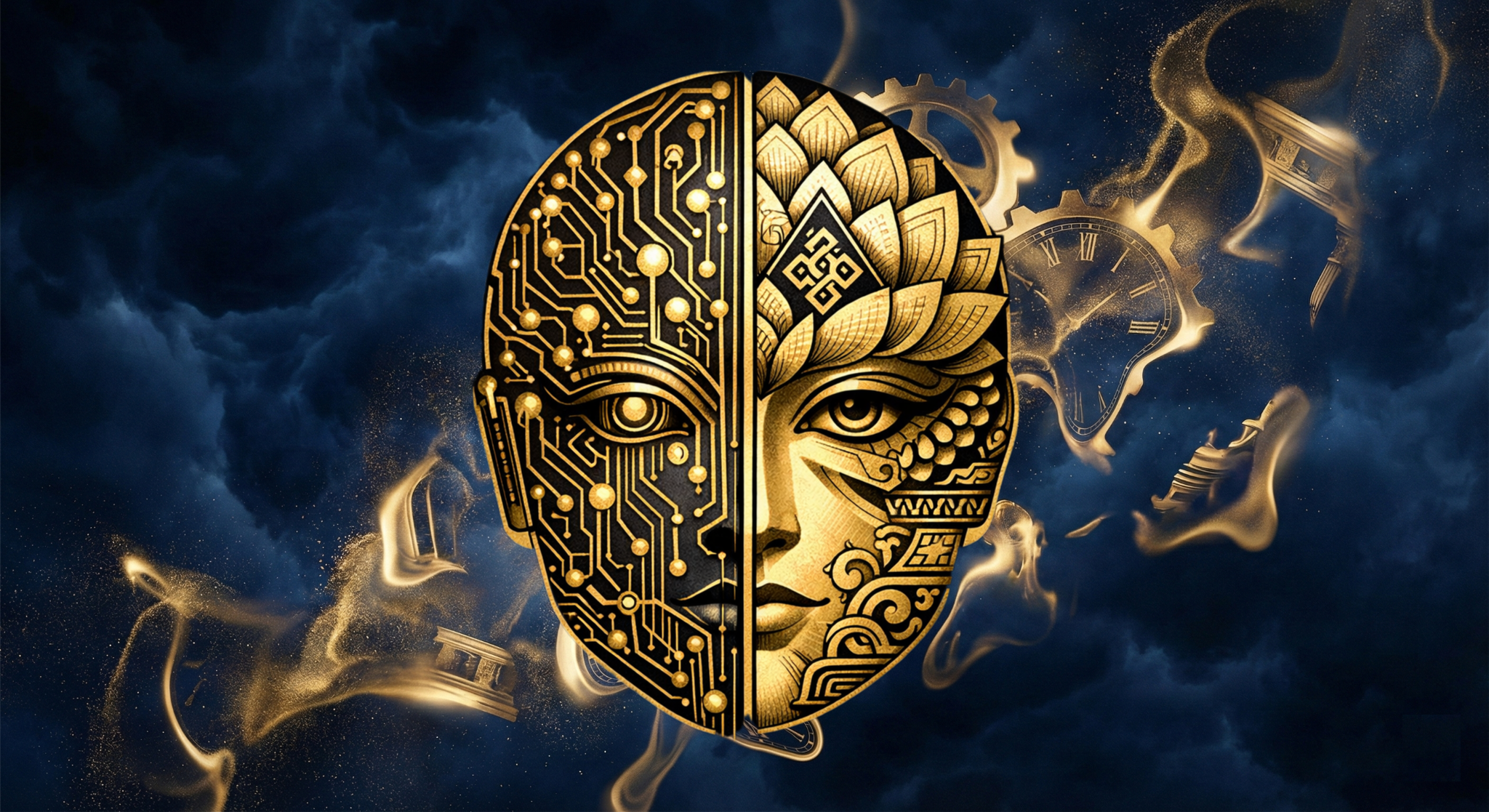
Whenever I hear the word “Karma,” my mind doesn’t go to ancient scriptures or mountain-top gurus. It goes to that moment when I instinctively slam on the brakes because a red car swerved two lanes over. I didn’t think about it; I just did it.
We often toss around the word Karma to mean “cosmic justice”—the idea that if you steal a cookie today, you’ll stub your toe tomorrow. But if you dig into the ancient texts, Karma isn’t about punishment. It is about memory.
In my previous posts, we explored how engineers are trying to build memory into silicon chips. But thousands of years ago, scholars in India were already mapping a different kind of hard drive. They described a system in which memory isn’t merely a passive record of the past but an active force shaping the future.
Today, let’s bridge the gap. Let’s look at how the ancient “Karmic Code” maps surprisingly well to our modern understanding of the brain.
The “Rosetta Stone” of the Mind
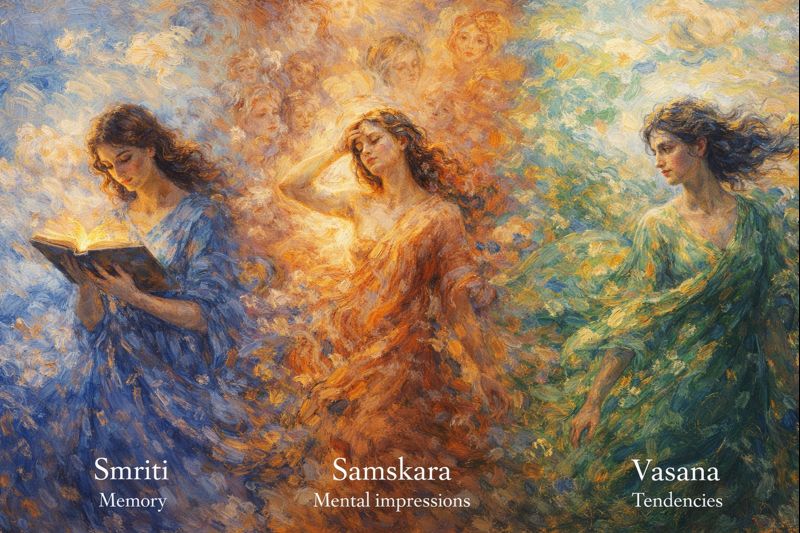
When we say “memory” today, we usually mean remembering a phone number or a childhood birthday. The ancient framework argues that this is too simple. They viewed memory as a composite system.
If we lay the ancient Sanskrit terms next to a modern Neuroscience textbook, a fascinating picture emerges.
1. Smriti: The Surface (Episodic & Semantic)
In the Yoga Sutras, Smriti is described as the conscious recollection of the past. It is the “fluctuation of the mind”—the surface-level retrieval of information.
- The Modern Twin: This is what we call Episodic Memory (your autobiography) and Semantic Memory (facts like “fire is hot”). It is the file you consciously open on your desktop.
2. Samskara: The Groove (Implicit & Procedural)
This is where it gets interesting. Samskara is the closest biological equivalent to “Karmic Memory”. The texts describe these as “grooves” or latent impressions left in the mind by every thought and action.
- The Modern Twin: We refer to this as Neuroplasticity. When you repeat an action, you strengthen a neural pathway. You are literally carving a “groove” in your brain.
3. Vasana: The Filter (Schemas)
If you have enough Samskaras (grooves) bundled together, they form a Vasana—a deep-seated tendency or desire.
- The Modern Twin: Psychologists call these Schemas. If you have a “trust issues” schema (Vasana) stemming from past negative experiences (Samskaras), you will filter every new interaction through that lens.
The Biology of Karma
The most striking bridge between these two worlds is the mechanism by which a memory becomes destiny.
The ancients said: Every action leaves a Samskara. If repeated, it becomes a Vasana, compelling you to act the same way in the future (Karma). Modern science agrees, but it uses different terminology: neurons that fire together wire together.
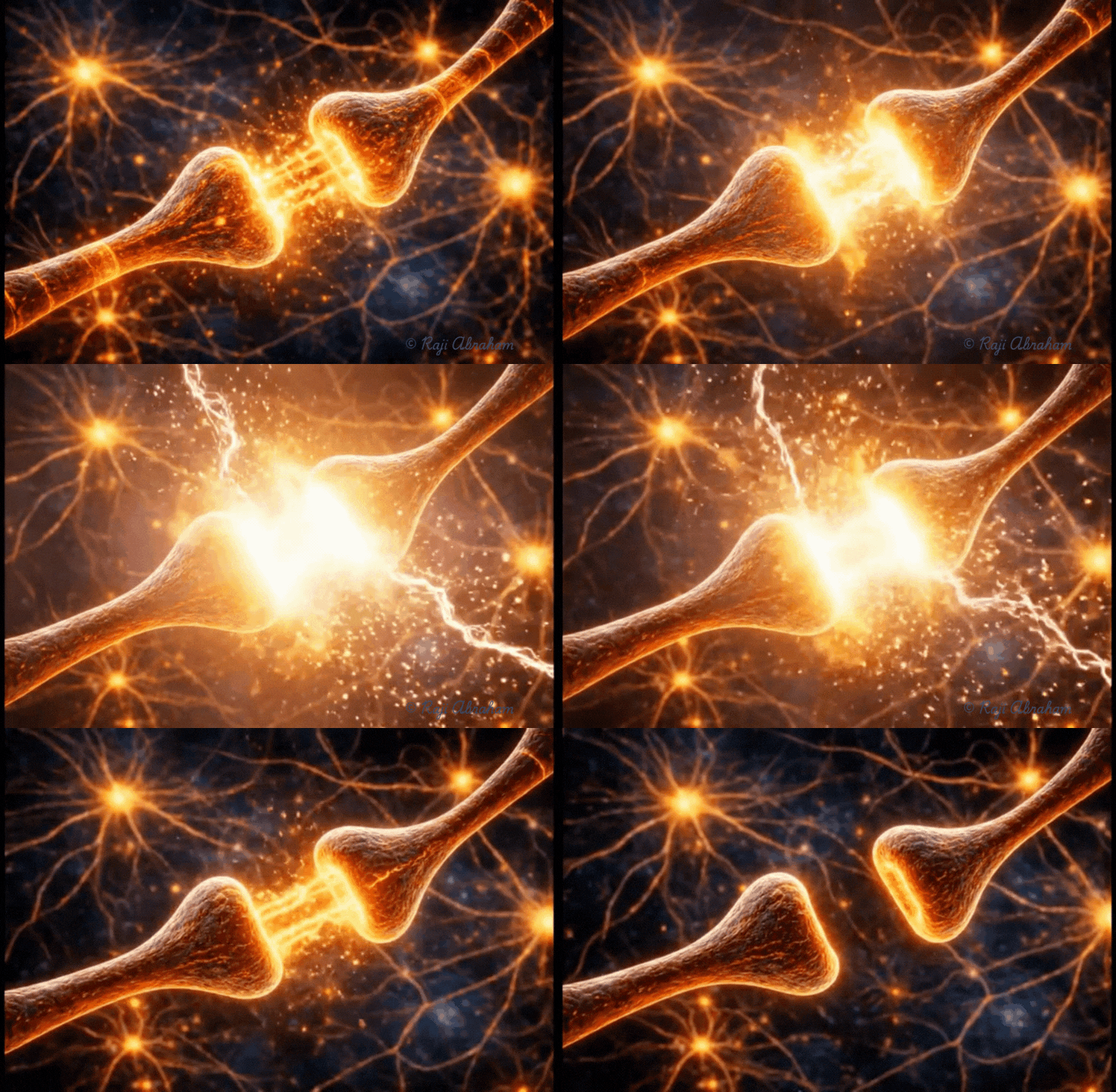
This is Hebbian Learning. If you get angry every time you are stuck in traffic, you are strengthening the synaptic connection for “traffic = rage”. Over time, you don’t choose to be angry; your brain slides down the groove you carved for it. The “Karmic consequence” isn’t a cosmic judge punishing you; it is your own biology executing the code you wrote. Researchers such as Dr. Richard Davidson have found that practices such as meditation can alter cortical thickness and gamma-band activity. In ancient terms, they are “burning the karmic seeds.” In modern terms, they are rewriting the neural code
The Storehouse vs. The Hard Drive
While the mechanisms overlap, there is a profound difference in scope. In our modern digital world, we view memory as a storage device. We aim to store data to predict the future or manage the present. It is a utilitarian tool.
The Karmic framework views memory as Momentum.
In this view, memory is not passive data sitting on a server. It is an active agent. It has weight. It pushes you. Alaya-vijnana (Storehouse Consciousness) is described as a repository of “karmic seeds” that influence conscious thought without the individual’s awareness.

Think of it like this:
- Modern Memory: A library where you go to find a book.
- Karmic Memory: A current in a river that steers your boat, whether you are paddling or not.
The Great Convergence
We are living in a unique time when the “First-Person” science of the East (introspection/meditation) is finally converging with the “Third-Person” science of the West (neuroscience/biology).
Whether you call it a Samskara or Long-Term Potentiation, the lesson is the same: You are what you repeat.
We are building digital brains that learn from patterns, just as we do. But perhaps the most important lesson the “Digital Brain” can learn from the “Karmic Brain” is that memory isn’t just about storage; it’s about trajectory.
References
- “Psychology in the Indian Tradition” by K. Ramakrishna Rao and Anand C. Paranjpe
- “The Embodied Mind: Cognitive Science and Human Experience” by Francisco Varela, Evan Thompson, and Eleanor Rosch
- “Consciousness in Ancient India“ by Subhash Kak
- “Destructive Emotions: A Scientific Dialogue with the Dalai Lama” by Daniel Goleman
- “The Gods Within: On the Vedic Understanding of Mind and Neuroscience” by Subhash Kak
- “Neurophenomenology: A Methodological Remedy for the Hard Problem” by Francisco Varela
- “Karma, Mindfulness, and Neuroplasticity” (Various Authors in Mindfulness Journals)

I found this reading particularly intriguing because I was able to relate it to my own meditation experiences. The concept of “burning karmic seeds” resonated with me as a modern parallel to rewriting neural pathways. I am also curious about what you mentioned earlier regarding cosmic justice—specifically, how it operates uniformly across all beings. It seems almost like an observability system functioning on a cosmic scale, continuously ensuring balance and justice.
Thanks for your comment, Pradeep. The human desire for “cosmic fairness”, the belief that the universe should reward the good and punish the wicked, is a fascinating intersection of evolutionary psychology, cognitive science, and social history. It isn’t just a religious concept; it is a deeply rooted psychological mechanism that helps us navigate a complex world. But it is purely human-made. However, that does not rule out a higher order “cosmic law.” Our conscious mind is too feeble to comprehend it.