
Iremember the smell of ionizing dust in the lab. It was the early 1980s, and I was hunched over an 8085 microprocessor kit inside our Dept of Computer Science Lab during my master’s degree program. To speak to it, you couldn’t use a polite request or even a simple English word. You had to speak in the machine’s cold, rhythmic heartbeat: Hexadecimal. Each instruction was a precise physical location, a toggle of a switch, a punch in a paper tape. If the machine was a stubborn mule, we were the ones learning to bray in its tongue just to get it to move an inch.
Since those days of paper tape and tape operating systems, we have been on a relentless, fifty-year quest to put distance between the human mind and the machine’s silicon. We called this “Abstraction.” But as we enter the era of Generative AI, we have to ask: Have we been building a bridge, or just a more elaborate set of crutches?
The Why: The Burden of the Middleman
For decades, the “High-Level Language” was our Great Hope. We created COBOL and FORTRAN so we wouldn’t have to think like a processor. We created Python and Node.js so we could think like architects. But here is the irony: even these “human-readable” languages are still just a translation layer.
Procedural Peasants
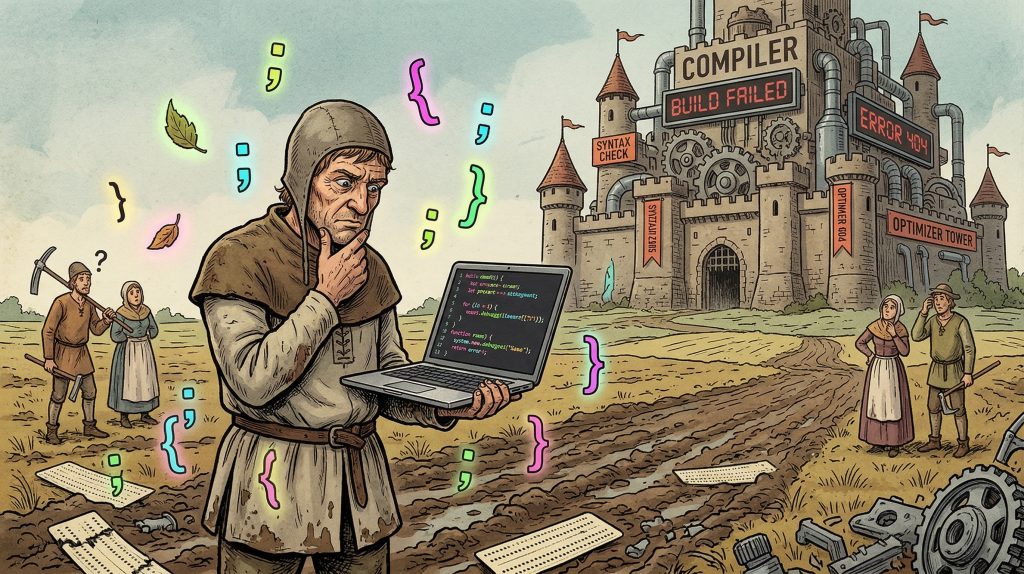
We are still obsessing over the “How”—the semicolons, the indentation, the strict syntax that a computer demands. In our attempt to make machines understand us, we ended up training generations of humans to think in the rigid, linear logic of a compiler. We became the “Procedural Peasants,” following recipes to chop onions while the machine sat waiting for the next byte.
The What: Four Eras of the Interface
The history of how we talk to computers—the Human-Machine Interface (HMI)—is a story of shrinking the “Cognitive Load.”
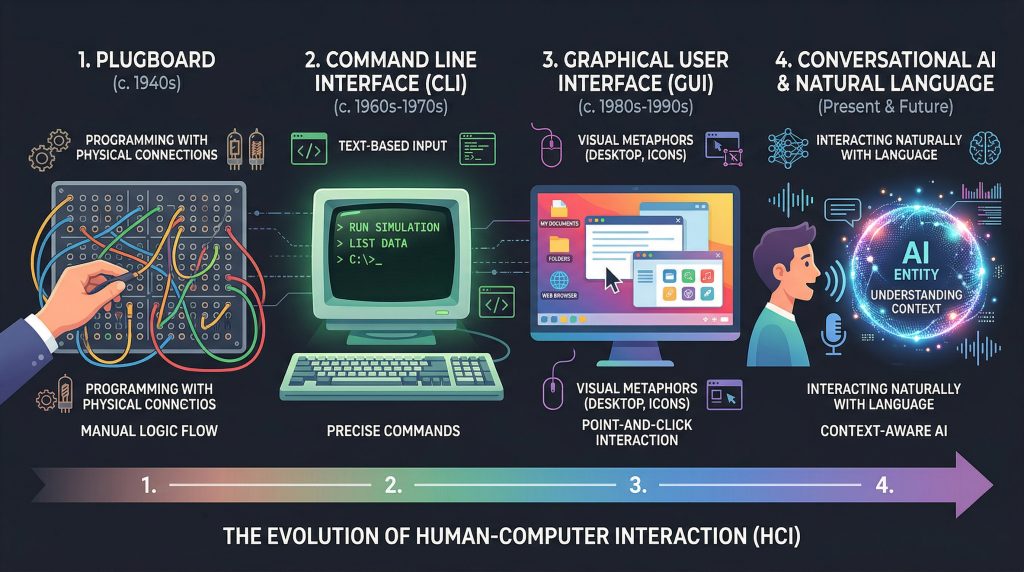
- The Era of Physical Logic: Where the “interface” was a plugboard. You didn’t write code; you routed electricity.
- The Era of Symbolic Command: The rise of the CLI (Command Line Interface). We memorized incantations—DIR, MOV, JMP—and if you missed a single character, the machine simply refused to acknowledge you.
- The Era of Visual Metaphor: The GUI. We stopped memorizing and started recognizing. We clicked on folders and trash cans, using digital ghosts of physical objects to hide the complexity of memory addresses.
- The Era of Intent: This is where we stand today. We are moving from “Tell the machine how to do it” to “Tell the machine what you want achieved.”
The Modern Paradox: The Senior Developer Bottleneck
While we dream of an era of pure “Intent,” we are currently hitting a very expensive wall. Recently, Amazon—one of the world’s engineering powerhouses—had to apply the emergency brake to its AI-assisted coding. After a “trend of incidents” with a “high blast radius,” including a six-hour outage on its retail site and an AWS environment being accidentally deleted and recreated by an AI agent, the company issued a new mandate: Junior and mid-level engineers must now have every AI-assisted change signed off by a Senior Engineer.

The verification gap
This is the “Verification Gap.” AI allows us to generate code at 4.5x velocity, but it has created a massive bottleneck downstream. We are using 21st-century AI to write code, but we are still relying on 20th-century human “scar tissue” to make sure that code doesn’t blow up the world.
We have successfully automated the “Creation,” but we have stalled on the “Verification.” The Senior Developer has become the human filter for a machine-generated flood, spending nearly a full day each week just checking AI output.
The How: The Shift to Generative Agency
How do we solve this? The answer isn’t “fewer humans” or “more senior reviews.” The answer lies in rethinking the interface’s target. Currently, our AI is writing code for humans to read, even if no human ever intends to read it. We are generating massive amounts of “Middleman Syntax” that requires a Senior Developer to act as a translator. If the AI writes the instructions and the machine executes them, why are we still insisting that the instructions look like a 1990s textbook?
The “How” of the Generative Era isn’t just about better prompts. It’s about creating Self-Correcting Contexts. We need to move away from low-level syntax and toward high-level, intent-based declarations where the AI manages the data flow and the human manages the mission. We must stop treating AI as a faster typewriter for our old languages and start building an architecture in which “Verification” is as automated and agentic as “Creation.”
Coming Up Next…
If the human mind is finally free to express pure intent, why does the machine still feel so slow?
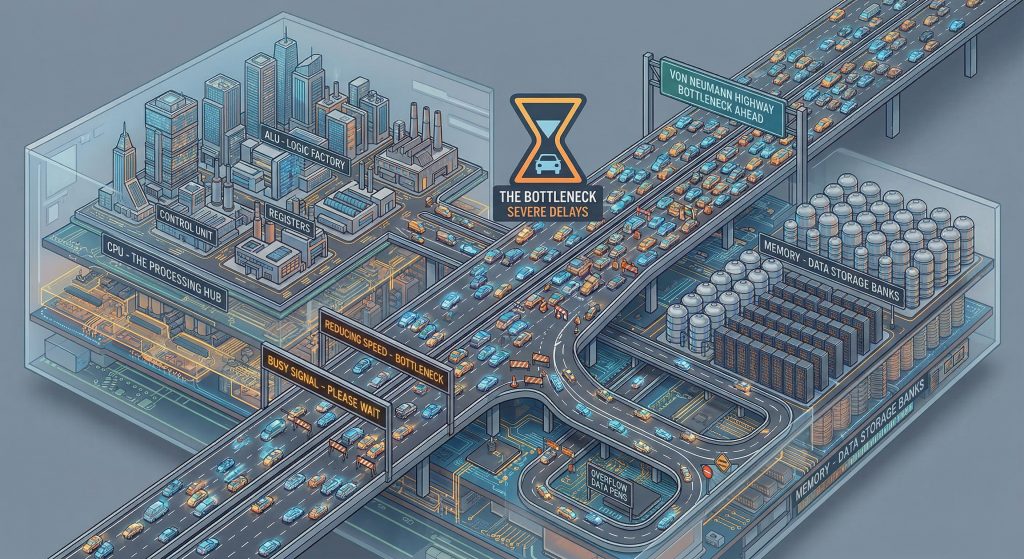
The Von Neumann Tax
Join me for Part 2: The Von Neumann Tax, where we’ll look at the physical “traffic jam” inside your computer that is holding back the true potential of Agentic AI—and why the very architecture of our hardware is overdue for its own Renaissance.
